

Skip to content
Dedicated implant care in Bergen County, New JerseyQuestions? (551) 368-2476
Tooth Replacement

Dental Implants in Hackensack, NJ

If missing teeth are changing how you eat or smile, you can start by talking through your options.

A permanent, natural-feeling way to replace missing or failing teeth. Planned in 3D, placed by a specialist, and designed to last for decades.

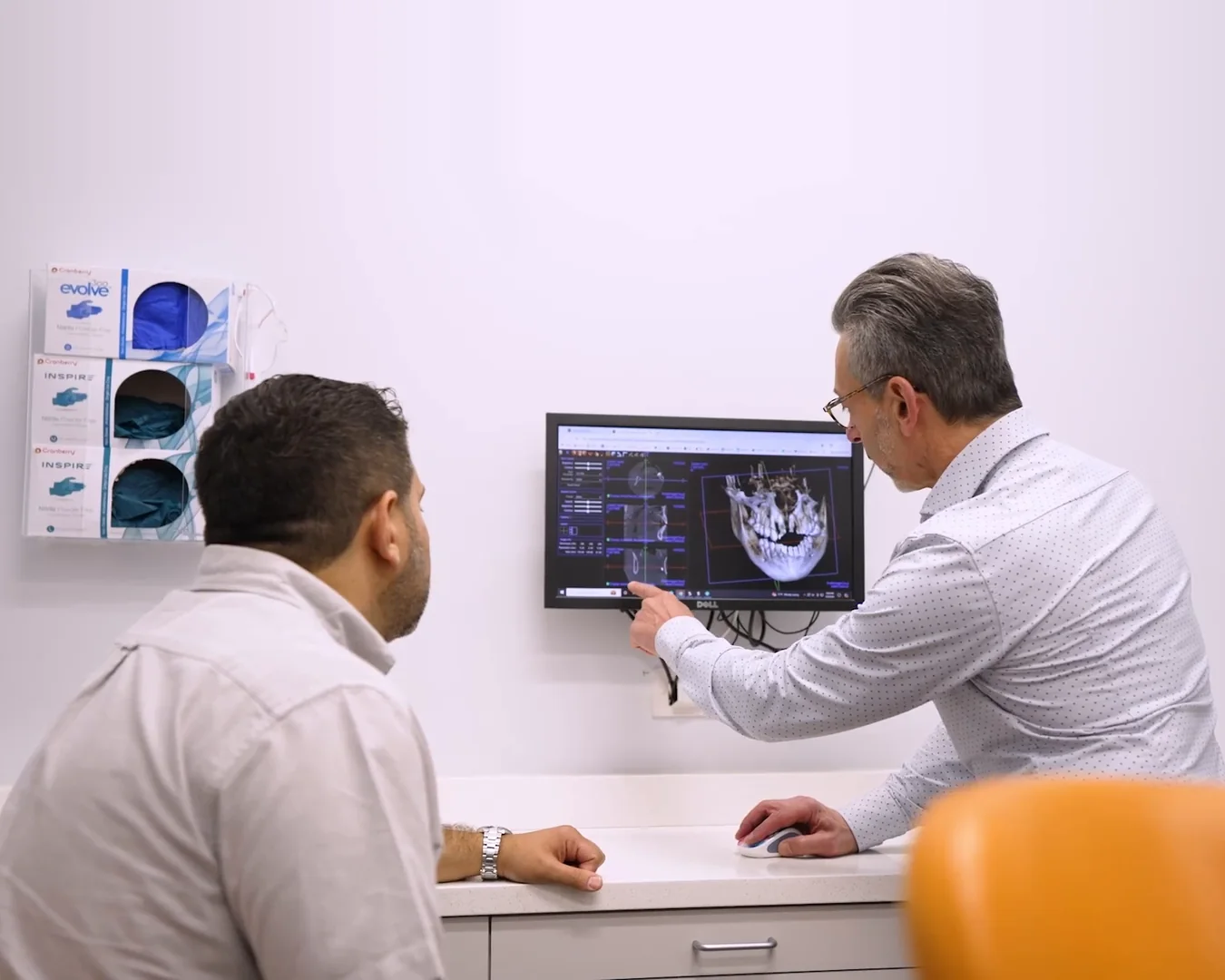
A patient and a dentist looking at his 3D scan on a monitor in a treatment room
Portrait of Dr. Alan Meskin
Dr. Alan MeskinNYU-trained prosthodontist
5.0Google rating
The Treatment

What Are Dental Implants?

A dental implant is a permanent replacement for a missing or failing tooth, built from the root up rather than resting on your gums or the teeth beside it. It replaces the whole tooth, not just the part you see.

Every implant has three parts. A small titanium post takes the place of the tooth root and is set into the jawbone. An abutment connects to that post and rises through the gum. A custom crown sits on top and looks and works like a natural tooth. Because the post fuses with your jawbone through a process called osseointegration, the implant stays firmly in place while you eat, speak, and smile.

Read more

Dental implants are used to replace anything from a single tooth to an entire arch, and they are the only tooth replacement that preserves the jawbone underneath. That is why, when the situation allows for them, they are considered the gold standard.

The Essentials

Dental Implants at a Glance

A dental implant with its crown, standing on a blue surface

What Dental Implants Give You Back

Dental implants are the only tooth replacement that behaves like the real thing, which is why they are considered the gold standard.

Read more

What patients notice, from day one and years later:

  • Feel like natural teeth. Fixed in place, so nothing shifts or comes out.
  • Preserve your jawbone. The post replaces the root and stops the bone from shrinking.
  • Full biting strength. Eat what you want, chew on either side without thinking about it.
  • Designed to last. Decades for the crown, often a lifetime for the post.

What They Are Made Of

The implant post is titanium in almost every case, chosen because bone bonds to it naturally and it has decades of clinical research behind it.

Read more

Zirconia is a newer, metal-free alternative that some patients prefer for aesthetic or biocompatibility reasons.

  • Titanium. The standard. Lightweight, biocompatible, extensively researched.
  • Zirconia. A tooth-colored ceramic option, useful in visible sites or for patients who prefer metal-free.
  • The crown on top is usually porcelain or zirconia, matched to the shade and shape of your other teeth.

How Long They Last

Well-placed and well-maintained dental implants are designed to last for decades, and the post itself often lasts a lifetime.

Read more

The crown on top is a wear part, like anything you use every day, and may need replacement or maintenance over the years. What extends an implant's life most is not the material, it is good daily brushing and flossing, regular check-ups, and the skill of the specialist who placed it.

Are They Safe?

Yes. Dental implants have been in wide clinical use for over 40 years, with success rates around 95 percent when placed by a trained specialist, according to major long-term studies.

Read more

The surgery itself is a routine, focused procedure done under local anesthetic, with sedation available for patients who want it. As with any minor surgery, healing depends on general health and habits like smoking, which is why the consultation covers your full history before we plan anything.

Ideal Candidates

Who Can Have Dental Implants?

Most healthy adults are candidates for dental implants, and many people who were told no elsewhere still qualify here with the right preparation.

Read more

Five things get checked at your consultation, each with a straightforward path forward if it needs work. A 3D scan gives us a definite answer.

01

Adult with a fully developed jaw

Read more

Implants are for adults, because the jaw has to have finished growing before a permanent post goes into it. Placing an implant in a jaw that is still developing can push a tooth out of position later or leave the implant misaligned. There is no upper age limit. Patients in their 70s, 80s, and 90s receive implants regularly and heal well, since what matters far more than age is general health, the quality of the bone, and how well you look after your mouth.

02

Enough bone at the implant site, or a plan to rebuild it

Read more

An implant fuses directly to your jawbone, so there has to be enough healthy bone in that spot to hold it. Bone begins to shrink the moment a tooth is lost, and the longer a gap sits empty, the more it recedes. This is one of the top reasons patients are told "no implants" by another office, and it is often not the whole story.

  • Your 3D scan measures the exact height and width of bone available at each planned site.
  • Small deficits are treated with focused grafting, sometimes done at the same visit as placement.
  • Larger deficits are rebuilt with a graft before implants go in, adding a few months to the plan.
  • Angled implant designs like All-on-4 can work with limited bone in the back of the jaw, sometimes avoiding grafting altogether.

If you have been told your bone is not enough, it is worth a second look with a proper scan.

03

Healthy gums, with any active disease treated first

Read more

Gum disease is the leading cause of tooth loss in adults, and it does not go away on its own. Because an implant sits in the same bone that gum disease attacks, any active infection has to be under control before implants can be placed. Signs of active disease include gums that bleed easily, receding gum lines, deep pockets around the teeth, and bone loss visible on x-rays.

The important part: a history of gum disease does not disqualify you. Even patients with significant past bone loss can go on to have successful implants once the infection is treated with deep cleanings, antibiotics, or periodontal procedures, and once ongoing maintenance is in place. What matters is that the disease is controlled and stays controlled.

04

General health that supports healing

Read more

Implant placement is a routine, focused surgery, and healing depends on the same things any other surgery does. Most healthy adults qualify, including patients with well-managed chronic conditions.

  • Well-controlled diabetes is usually fine. Uncontrolled diabetes with unstable blood sugar meaningfully raises the risk of implant failure and needs to be brought under control first.
  • Certain medications can affect bone healing, including some osteoporosis drugs and long-term steroids. We review your full medication list at consultation.
  • Autoimmune conditions and treatments are planned around case by case, sometimes in coordination with your physician.
  • Radiation to the jaw or head and neck in your medical history is a case-by-case conversation, since it changes how bone heals.
05

Willing to quit smoking, and committed to daily oral hygiene

Two lifestyle factors affect implant success more than almost anything else.

Read more

Smoking narrows the small blood vessels in the gum, slows the fusion of the implant to the bone, and meaningfully raises the risk of failure both during healing and for years afterward. We ask you to stop before surgery, through the whole healing period, and ideally for good.

Oral hygiene is what protects implants long term. An implant does not decay, but the gum and bone around it can become infected if plaque and tartar are allowed to build up, a condition called peri-implantitis. Brushing, flossing, and regular professional cleanings are what turn a well-placed implant into one that lasts for decades.

Dr. Alan Meskin, prosthodontist and implant specialistProsthodontist · Implant Specialist
  • Patients describe him as an artist with a gentle touch whose restorative work looks so natural no one can tell.
  • Complex and referred-out cases trusted to him by other dental offices.
Precision-Trained, Patient-First

Why a Prosthodontist for Your Dental Implants

NYU-trained specialist in replacing and restoring teeth.

Dr. Meskin is a prosthodontist dedicated to one thing: replacing and restoring teeth so they look, feel, and function like the ones you were born with.

Full credentials

He earned his Doctor of Dental Surgery degree and completed his specialty training in prosthodontics at NYU, then refined his implant work as an associate prosthodontist at ClearChoice, one of the largest dental implant networks in the country. Today he leads Hackensack Center for Dental Implants, where every case is planned in 3D, fabricated in an on-site lab, and designed around the patient sitting in front of him. He provides care in English, Spanish, and Russian.

Doctor of Dental Surgery
DDS, NYU College of Dentistry
Specialty
Certificate in Prosthodontics, NYU College of Dentistry
Experience
Associate Prosthodontist, ClearChoice Dental Implant Centers
Read Dr. Meskin's story →
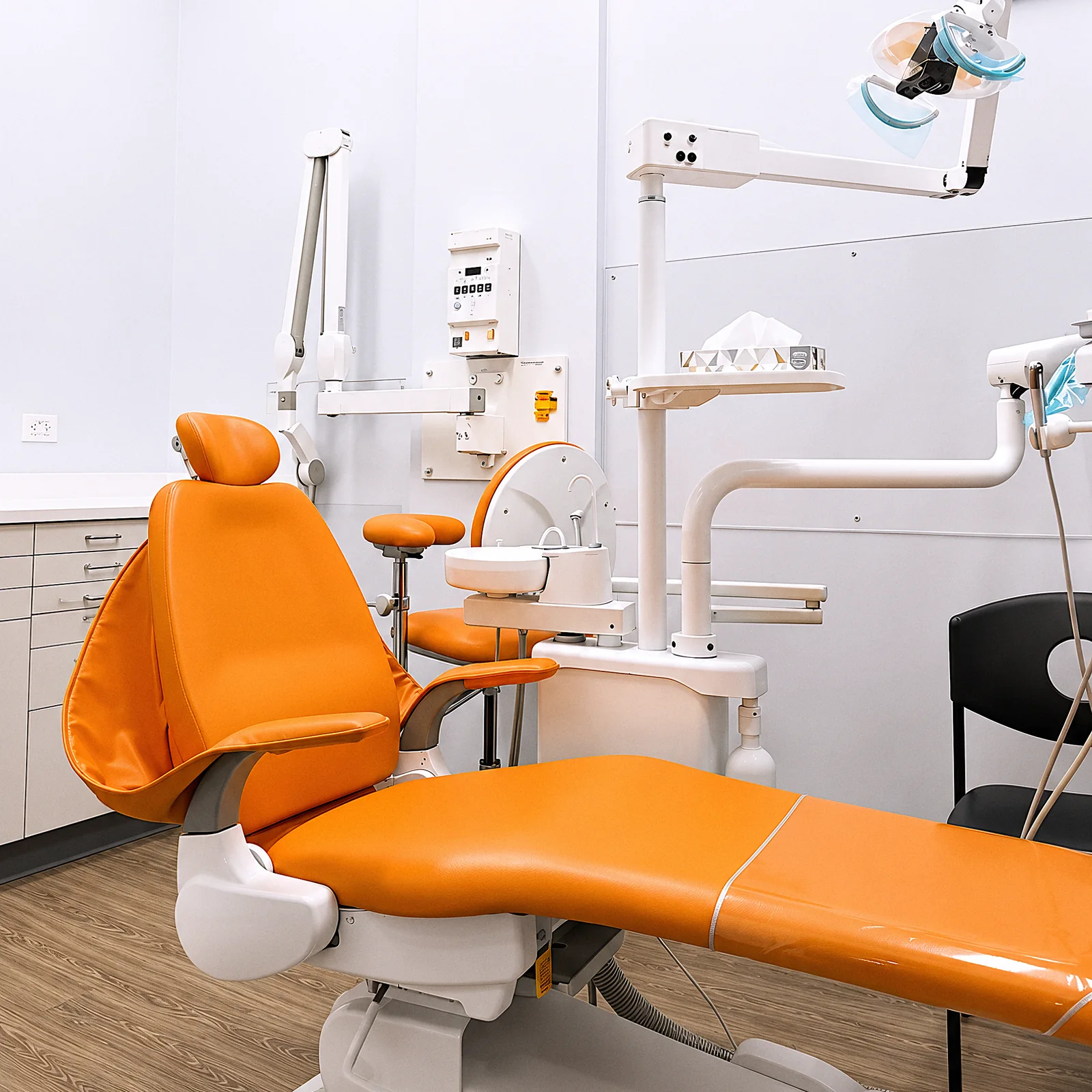
A treatment room with an orange dental chair under the light
Sedation

Comfort First: Sedation That Takes the Fear Out

Many of our implant patients tell us they put this off for years because they were afraid it would hurt. It does not have to. Whether you're getting a single implant, a bridge, or a full arch, we offer a full range of sedation, up to IV sedation, so you stay relaxed and comfortable from the first moment to the last. People often say the hardest part was working up the nerve to come in, and that the day itself was far calmer than anything they had built up in their head.

The Options

Types of Dental Implants

Dental implants cover everything from replacing one tooth to rebuilding a whole mouth.

Read more

Which option is right for you depends on how many teeth you are missing and the state of the ones around them.

01
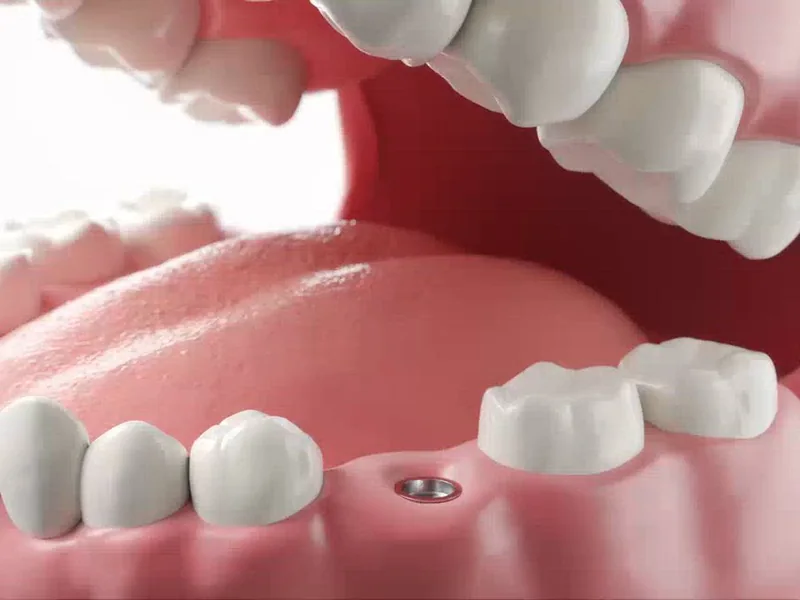
A model of the jaw with one implant post placed in the gap of a missing tooth

Single Tooth Implant

One implant replaces one missing tooth, without touching the teeth on either side. The most conservative option when you are missing a single tooth.

Learn more →
02
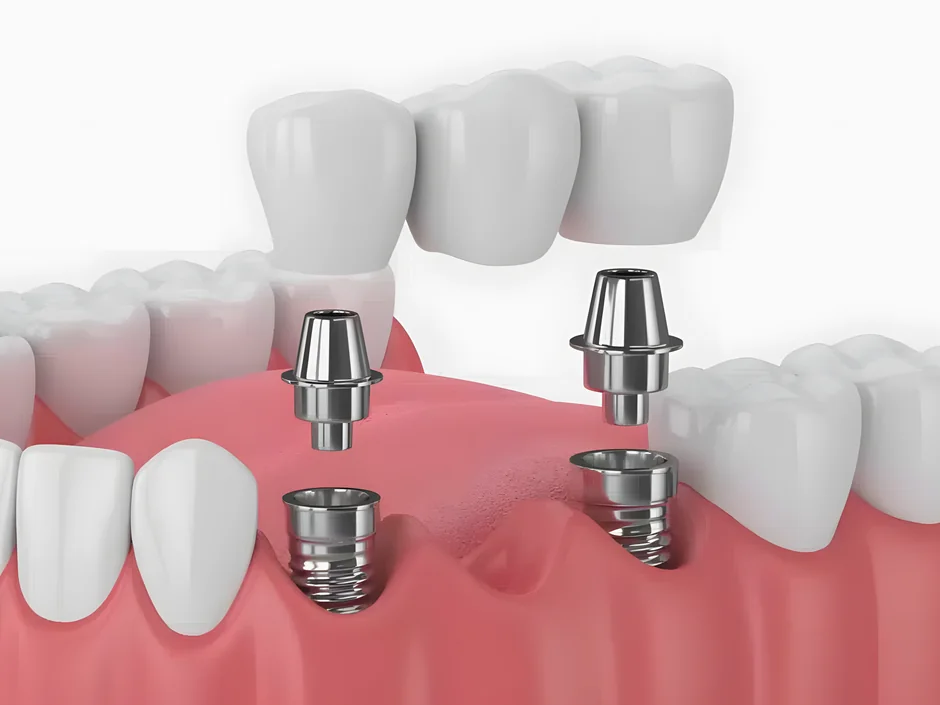
An illustration of a three-tooth bridge lowered onto two implants in the jaw

Implant Bridge

Two implants can support a bridge of three or four teeth in a row, replacing a span without grinding down healthy neighboring teeth. The efficient choice when you are missing several teeth together.

Learn more →
03
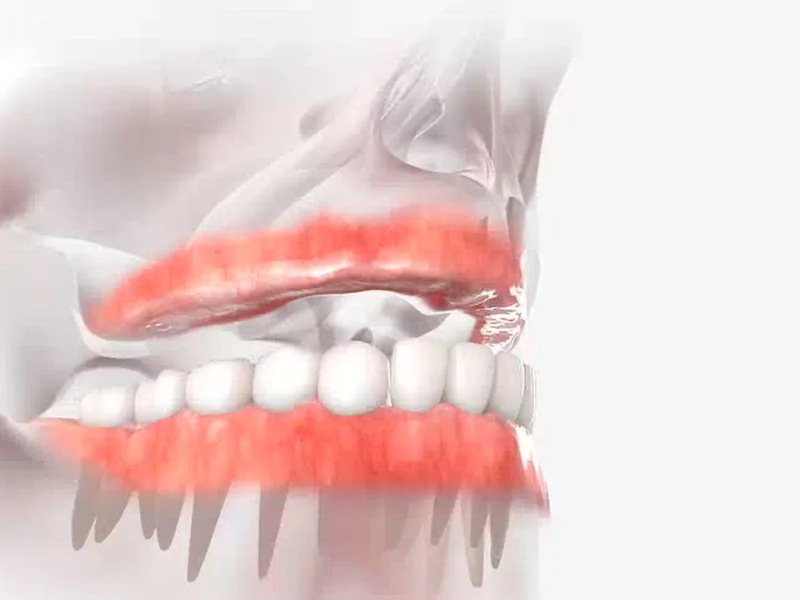
An illustration of a full arch of teeth fixed on implants in the jaw

All-on-X / Full-Arch Implants

Four to six implants support a fixed set of teeth that replaces an entire upper or lower arch.

Read more

Used when most or all of the teeth in an arch are missing or failing.

Learn more →
04
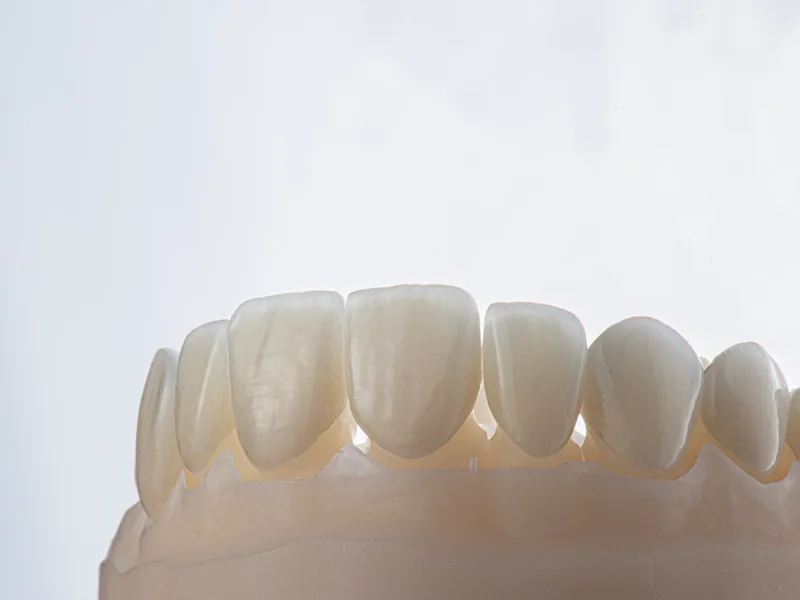
A full arch of ceramic teeth made for a full-mouth restoration, on a model

Full-Mouth Rehabilitation

A phased plan that combines several implant and restorative treatments to rebuild the whole mouth. For patients whose issues have stacked up beyond a single treatment.

Learn more →

Snap-In Overdenture

A removable denture that clips onto implants for far more hold than a traditional denture. Useful for some full-arch cases where a fixed set is not the right fit.
The Process

How Dental Implants Are Done

Every implant treatment follows four clear stages, from your first evaluation to your final teeth.

  1. 01

    Initial Consultation and Diagnostic Tests

    Your first visit gives Dr. Meskin the information needed to plan treatment safely and accurately.

    Read more

    We review your health history, examine your teeth and gums, and use 3D imaging to map the implant site.

    • A complete examination of your teeth, gums, bite, and missing-tooth site
    • A 3D cone beam scan to evaluate bone, nerves, and sinuses
    • Photographs or impressions to plan the appearance of your final teeth
    • A discussion of your goals, comfort options, and medical history
    • A clear treatment plan, timeline, and cost estimate
  2. 02

    Implant Placement

    Once the site is ready, the implant is placed into the jawbone using the position established during 3D planning.

    Read more

    Local anesthetic keeps the procedure comfortable, and sedation is available when appropriate.

    • Any required extraction, bone graft, or gum treatment is completed before or during placement.
    • The implant is guided into the planned position through a small opening in the gum.
    • A healing cap or temporary tooth may be provided, depending on the location and treatment plan.
  3. 03

    Healing

    During the next few months, the implant bonds with the jawbone in a process called osseointegration.

    Read more

    This creates a stable foundation for the final tooth. Most patients return to normal routines quickly while following simple instructions for diet, cleaning, and follow-up visits.

  4. 04

    Final Restoration

    After the implant has fully healed, we capture a detailed impression and create the final crown, bridge, or full-arch restoration.

    Read more

    Dr. Meskin checks the fit, bite, shape, and shade so the finished teeth feel comfortable and look natural.

Patient Stories

Real Patients, Real Stories

Hear from patients who rebuilt their entire smile and got their comfort and confidence back, in their own words.

Patient Reviews
View all testimonials →
Recovery

The Recovery Timeline

Recovery from dental implant surgery is usually milder than most people expect, and it happens in two layers.

Read more

The visible part, the healing you notice around your gum, wraps up in about two weeks. The invisible part, where the implant fuses with the bone underneath, takes a few months and is what makes the finished tooth permanent. Understanding both layers is what makes the timeline make sense.

A Typical Implant Recovery Timeline

  1. Day 0

    Placement. Minor soreness, soft foods, rest for the day.

  2. Days 1 to 3

    Peak swelling and soreness. Soft foods only. Usually milder than expected.

  3. Days 4 to 7

    Swelling drops off. Most people return to work.

  4. Weeks 2 to 4

    Stitches dissolve and gums heal. Still on a soft diet.

  5. Months 1 to 3

    The bone fuses to your implants. Keep protecting them with softer foods.

  6. Months 3 to 6

    Your final crown or teeth are placed. Back to a normal diet.

Common Questions

Frequently Asked Questions

Ask us your questions →
Am I too old for dental implants?

No. Age itself is not a barrier. Patients in their 70s, 80s, and beyond receive implants every year and heal well, provided general health supports it. What matters is your overall health and the quality of your bone, both of which are checked at your consultation.

Do dental implants hurt?

Most patients are surprised how comfortable it is. Placement is done under local anesthetic, and sedation is available for anyone who feels anxious. Any soreness afterward is usually managed with simple over-the-counter care.

How long does the implant process take?

From placement to your final tooth is usually a few months, because the implant needs time to fuse with the bone. Appointments themselves are short. Most of the timeline is quiet healing, not chair time.

How much do dental implants cost?

Cost depends on the type of case, from a single implant to a full-arch reconstruction. After your 3D scan you receive a clear written estimate with no surprises, plus financing options that spread the cost into monthly payments.

Full cost breakdown →

What if I do not have enough bone?

You may still qualify. Focused bone grafts can rebuild sites where the bone has shrunk, and angled implant designs like All-on-4 are built to work with limited bone. A 3D scan is the only way to know for certain, and many patients who were told no elsewhere still qualify here.

How long do dental implants last?

With good hygiene and regular check-ups, the implant itself can last for decades, often for life. The crown on top is durable and can be maintained or replaced over the years if needed.

Do you offer financing?

Yes. We will find a way. We try every avenue, and our dedicated team of treatment coordinators will help you find a plan that fits. We work with Cherry, HFD, Proceed, and CareCredit, and we verify any insurance benefits up front.

It Starts With A Conversation

Experience Exceptional Dental Care

Schedule your consultation today and see how different implant care can feel. At Hackensack Center for Dental Implants, your comfort, your confidence, and your smile always come first.

No pressure.Start by getting answers.
No guessing.Your treatment is based on your actual needs.
No one-size-fits-all.The plan is personalized to you.
(551) 368-2476163 Main Street, Suite A1, Hackensack, NJ 07601

Tell us what you want to change

Call NowBook Consultation